Vietnam vs China Panels: Cost, Compliance and Supply Stability
Panel buyers who moved sourcing out of China in the last few years were not looking for the lowest quotation — they were looking for a landed cost they could predict. Vietnam's plantation veneer base, a published monthly capacity above 100 × 40ft at the larger mills, and a duty position marketed as no anti-dumping tax for EU and US importers all change the arithmetic. The three factors do not move together, which is what makes the comparison worth doing carefully.

Key takeaways
- Compare landed cost rather than ex-works price: duty treatment for EU and US destinations is part of the mill's published position.
- Veneer supply is the structural difference — a base of plantation acacia, eucalyptus and pine keeps lines running when imported veneer tightens.
- Read capacity as a scheduling statement: above 100 × 40ft per month means a trial order does not have to wait its turn.
- Compliance paperwork now arrives at the enquiry stage, and EUDR questions are asked before samples, not after the contract.
What actually differs between the two supply bases
The obvious difference is labour and energy cost, and it is also the least durable one, because it moves every year in both directions. The difference that lasts is upstream: Vietnam's mills sit on a dense plantation veneer chain of acacia, eucalyptus and pine, so core stock is grown and peeled within the country rather than carried in on container freight. That matters most in the quarters when imported veneer gets tight and every mill in the region is bidding for the same cargoes.
Scale is the second difference, and it is easier to verify. Dongstar Wood, working out of Yen Bai Province in northern Vietnam, publishes 48,000 m² of factory space, 16+ automated production lines plus a monthly capacity above 100× 40ft, alongside a self-description as a B2B supplier for European and American buyers. Those are numbers an importer can check against a shortlist before any correspondence begins.
| Item | Position published | What to test yourself |
|---|---|---|
| Duty treatment | No anti-dumping tax for EU and US markets | HS code on the proforma and the importer of record |
| Veneer base | Plantation acacia, eucalyptus, pine | Species mix on the specification sheet |
| Monthly capacity | Exceeding 100 × 40ft | How a trial order is scheduled beside contract volumes |
| Compliance set | ISO, CE, SGS, FSC, EUDR, BSCI | Certificates with scope lines, requested one by one |
| Custom formats | Up to 1830 × 3830 mm | Whether your size is a routine press setting or a special |
Duty exposure sits inside the landed cost
Two suppliers can quote the same panel price and still land at different numbers, because duty treatment is applied to the country of origin rather than to the negotiation. Where a mill's own category pages carry the line no anti-dumping tax for EU and US destinations, that is a statement worth writing into the enquiry, together with the HS code your customs broker expects to declare.
Put duty beside freight and financing rather than treating it separately. A duty line that disappears from the calculation is often larger than the difference between two mills' unit prices, and it is the only one of the three that a supplier can confirm in writing before the order is placed.
Stability: why a monthly capacity number beats a headline price
Price comparisons are easy to make and easy to invalidate. A quotation that undercuts the field by a wide margin usually reflects veneer bought at the bottom of a cycle, and it will be revised on the next enquiry. Capacity, by contrast, is published once and tested continuously: a mill that runs above 100 × 40ft a month has enough press time to keep a contract volume and a trial order in the same schedule.
Ask how the factory spreads work across 16+ lines as well. A supplier that can name the lines your product family will run on is describing a plan; a supplier that answers with a delivery window is describing a wish. Buyers who trace that manufacturing history usually start on the company's own pages, where the founding year, floor areas and export reach appear in one place.
Compliance questions that arrive before the sample
European enquiries now open with documentation rather than samples. The useful split is between what a mill holds and what it is prepared for: ISO, CE, SGS, FSC, EUDR and BSCI are the six schemes named on the client's pages, and FSC plus CE documentation cover the construction and interior uses that most importers are buying for.
EUDR deserves its own line in the enquiry. Ready wording is not the same as a due-diligence statement that maps a consignment back to the supply area it came from, and that statement is what a distributor's compliance team will eventually ask to see. Request it with the quotation instead of in the week the vessel sails.
Worked example: a five-container trial inside a 100-container month
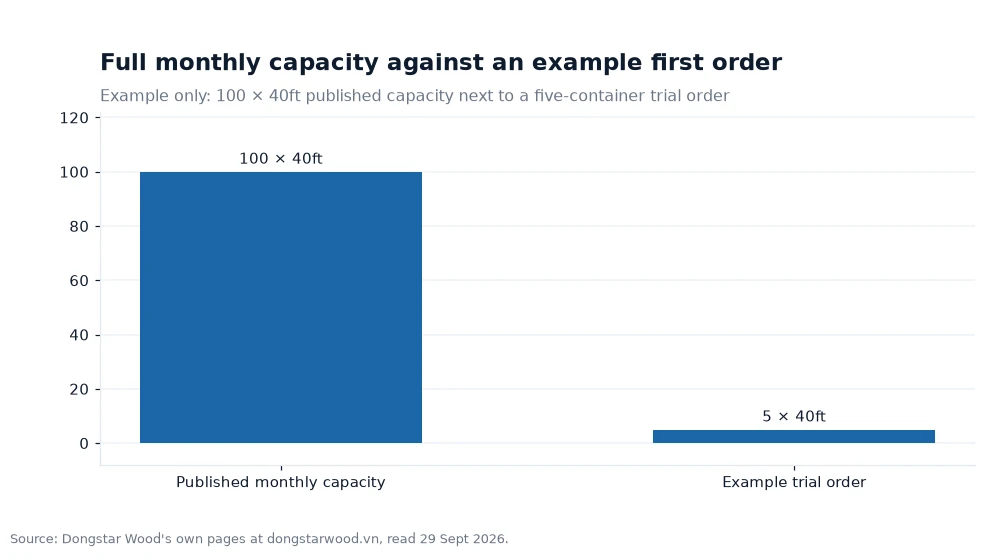
Trial orders are usually smaller than buyers assume they must be. Take the published capacity as an example: 100 × 40ft per month ÷ 4 weeks = 25 × 40ft per week of output. A five-container trial is therefore 5 ÷ 25 = one fifth of a single week's production, or 5% of the month — a size that can be scheduled without renegotiating the mill's existing programme.
Run the same logic on panel area. Take the 1220 × 2440 mm format: 2.98 m² (1.22 × 2.44 m) a sheet, so five containers of 500 sheets each carry 2,500 sheets × 2.98 m² = 7,450 m² of panel. That is the figure your storage plan and your own production line have to absorb, and it is a far more useful measure of a trial order than the container count alone.
Where an intermediary adds cost instead of value
Brokers earn their margin on information: they know which factory is running which product family, and they carry the correspondence. That value falls away as soon as the importer can read the same facts from published pages, because the broker then becomes a second translation layer between your specification and the press schedule. Directory sites are the weakest starting point of all, since a paid Plywood Supplier position reflects advertising budget rather than press time.
The test is simple. Ask for the factory name, the size range in millimetres and the glue classes offered. A mill that trades direct answers with 1250 × 3000 mm, 1250 × 2500 mm and 1220 × 2440 mm in between formats, custom panels to 1830 × 3830 mm, and a glue list running from MR through WBP to Phenolic Dynea. An intermediary answers with a price and a hope.
Frequently asked questions
Is Vietnamese panel supply cheaper than Chinese supply?
Not always on unit price, and never on unit price alone. The client positions Vietnamese supply as more cost-effective for European wholesale distribution, where duty treatment, freight and financing sit on top of the ex-works figure. Compare the landed number for your own destination before drawing a conclusion.
Does a five-container trial order disrupt a mill's contract customers?
It should not. Published capacity above 100 × 40ft per month works out at about 25 × 40ft a week as an example, so a five-container trial occupies roughly a fifth of one week. Trial orders are normally placed to test packing, flatness and surface finish before a larger programme is scheduled.
Which documents should accompany a first European enquiry?
Ask for the certificates that match your end use, not a full pack of logos: CE documentation for construction and interior panels, FSC for forest management and chain of custody, and an EUDR due-diligence statement that traces the consignment back to its supply area.
Turning the comparison into a specification
The last step is the least glamorous one: write the specification in millimetres and glue classes, then send it to two factories and compare the answers line by line. If your order mixes formwork and furniture panels, price them as separate families against the film faced plywood options and against the commercial plywood catalogue rather than as one blended quotation, because the press settings behind them are not the same.
The duty position, veneer base, capacity and document list compared in this article were checked directly on the manufacturer's own website, which I read on 29 Sept 2026 as referenced in this comparison as referenced in this comparison as quoted in this comparison[1].