Large Systems: Planning Above 100 Hectolitres
The figure most planners ask for first is the ceiling: the large commercial system page states equipment up to 100 hectolitres, while the site's overall published capacity range runs from 100 litres to 200 tonnes. HGMC builds large systems in that band with 2, 3, 4 or 5-vessel hot sides, electric, steam or gas heating, and control from a PID panel up to a fully automatic PLC with production-record printing. This article reads those published numbers as a planning tool for anyone specifying commercial brewery equipment above the micro scale.

Key takeaways
- The published large commercial ceiling is equipment up to 100 hectolitres, with hot products listed at 20 T to 50 T and 5 BBL to 20 BBL.
- Vessel count runs to five at this scale, which is what keeps a 100 HL brewhouse turning more than once a shift.
- Fully automatic PLC control with curve indication and production-record printing is the published top control level, and the record matters as much as the automation.
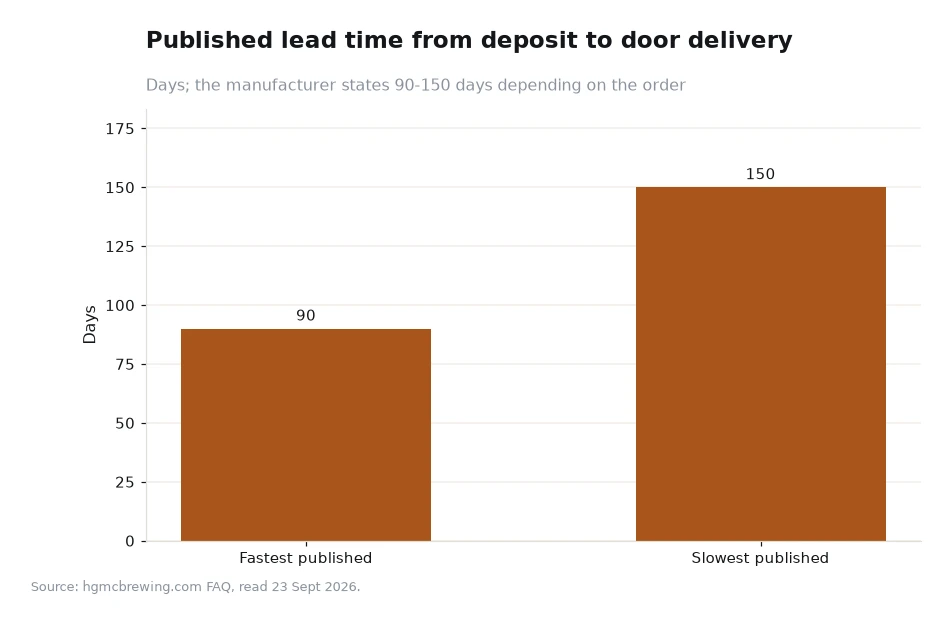
- Delivery is published as 90-150 days from deposit to door depending on the order, so a phased plant needs its second order placed months before the first line is full.
What the published ceiling actually says
Two published statements sit side by side and both matter. The large commercial system page describes equipment up to 100 hectolitres and says that whether a project is a half-barrel kit or a setup above 100 barrels, the manufacturer specifies and integrates all the necessary components. The overall site range is wider again, published as 100 litres up to 200 tonnes. Read together, that means the ceiling on a single brewhouse is not the ceiling on a plant: a 20-tonne or 50-tonne system is described as a hot product, and very large capacity is delivered as multiple brewhouses, fermenter farms and packaging lines rather than one enormous vessel. Planners who read the two statements this way avoid designing a plant around the biggest vessel they can buy.
One consequence deserves stating plainly for anyone planning a greenfield site: the hot side and the fermentation side do not have to grow in step. Published hot products from 20 T to 50 T are matched with fermenter farms, bright tanks and packaging lines that are specified separately, so a project can be quoted as one hot side with eight vessels today and sixteen in two years. Treat the brewhouse size as a decision about the whole plant and you will usually overbuild the part that is hardest to change later.
| Published reference | Volume equivalent (our arithmetic) | What it tells a planner |
|---|---|---|
| Large commercial system, up to 100 HL | 10,000 L per brew | The stated ceiling for a single large hot side. |
| 20 T system | about 20,000 L per brew | The lower end of the published 20 T-50 T hot products. |
| 50 T system | about 50,000 L per brew | The upper end of the published 20 T-50 T hot products. |
| Overall range to 200 T | about 200,000 L | The site's published capacity ceiling for multi-vessel plants. |
Where modular growth actually happens
Growth above the micro scale is almost always additive. The hot side may stay at 100 HL for years while fermentation capacity grows, because fermentation is the slower process and the cheaper increment: vessels, a bigger glycol system and more cold room. Packaging is the third increment, and the one that surprises budgets, since a bottling or canning line at this scale is a plant of its own. The published 2D, 2.5D and 3D design service matters here, because a layout that places fermentation tanks where they can be doubled later costs nothing extra at the design stage and a great deal later on. Give the design team your five-year volume, not your opening volume, and let them reserve the space.
The fermenter farm is also the least disruptive place to add automation later, because new tanks join the glycol loop and the control philosophy that are already running. That is the argument for paying attention to the 3D layout at the start rather than at the second order: a plant that begins with a 100 HL hot side and a modest farm can double the farm without touching the boiler, the electrical supply or the pipework, provided the drawings left room for it and the chiller was specified with headroom. Reservations made on paper cost nothing; reservations made in concrete cost a season.
Utilities and control at this scale
Heating choice is the first utility decision. Published options are electric, steam and gas direct fire, and at 100 HL the difference is not a preference but a site constraint: a steam system needs a boiler house, gas needs flueing and ventilation, electricity needs a supply that most light industrial units do not have at that rating. The published steam system design and the piping design that avoids wort aeration are both consequences of that earlier choice, and so is the fermentation side, where jackets run on both body and cone and cover headspace is calculated separately from the working volume. Control level decides how much of the record-keeping is automatic: a PID display panel, a PLC semi-automatic touch screen, or a fully automatic PLC with curve indication and production-record printing.
Worked example: a 100 HL brewhouse for one year
The arithmetic below is ours, and the assumptions are stated. Take a 100 HL brewhouse, which is 10,000 litres per brew, brewing four times a week for 48 weeks a year. Annual hot-side output is 10,000 x 4 x 48 = 1,920,000 litres, or 19,200 hectolitres a year. In barrels, 10,000 / 117 = about 85.5 BBL per brew and 85.5 x 192 = about 16,416 BBL a year. Now size the fermentation side. If a beer occupies a vessel for three weeks and you brew five days a week, three weeks of production needs 5 x 3 = 15 vessels of 10,000 litres, before you count a bright tank for carbonation. Two further checks: a second brewhouse line ordered once the first is at 80% utilisation should be placed at least 90-150 days before it is needed, the published delivery window from deposit to door; and the published example of a complete 10 BBL system at US$75,000-200,000, divided by 1,174 litres, gives about US$64-171 per litre of capacity as a scale reference only, since a 100 HL plant is specified item by item.
Frequently asked questions
How large a brewery system does the manufacturer publish?
The large commercial system page states equipment up to 100 hectolitres, while the overall published capacity range runs from 100 litres to 200 tonnes, with 20 T to 50 T systems listed as hot products.
How many fermentation tanks does a 100 HL brewhouse need?
Using our own example of five brews a week and a three-week fermentation, three weeks of production needs 15 vessels of the batch size, plus bright beer capacity for carbonation.
Plan the plant, then buy the brewhouse
Write the five-year target in hectolitres first, then decide what the first hot side has to be in order to reach it with fermentation and packaging additions rather than a rebuild. Ask for the layout in 3D, check the heating option against the utilities you actually have, and put the second-phase order date in the plan at the same time as the first. HGMC publishes a design service at no charge for space layout and vessel and piping design, exports to more than 120 countries, works in compliance with the ISO9001:2015 quality management system and keeps sales available around the clock. Compare the published brewery system options and the micro craft range as one ladder rather than two products, and raise utility questions before the drawings are signed off.
Capacities, control levels, delivery windows and quality-system wording above come from the manufacturer's own website at hgmcbrewing.com, read on 23 Sept 2026; the annual output, barrel and vessel-count figures are our own labelled arithmetic. Verify the current published figures before planning a plant[1].