Lead time in a custom perfume project is not one number, and the factory controls less of it than buyers assume. The calendar is set by a handful of long blocks — scent trials, stability testing, component tooling, filling — and by how much of the brand-side work runs in parallel with them. Buyers who plan the parallel paths first usually take weeks out of the schedule without spending anything.
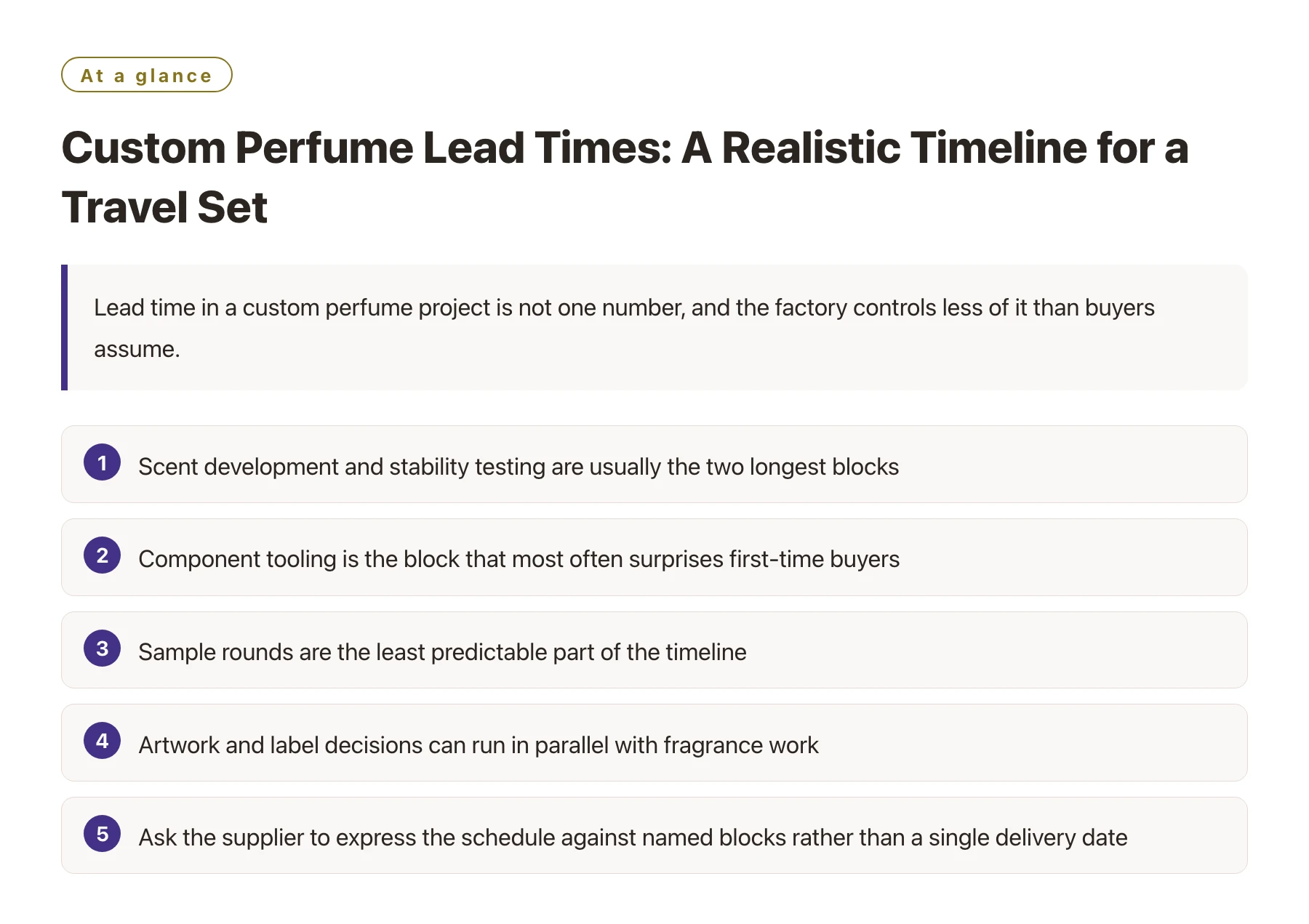
Key takeaways
- Scent development and stability testing are usually the two longest blocks, and testing can begin before the fragrance is final in its commercial form.
- Component tooling is the block that most often surprises first-time buyers, because it sits on the critical path before filling can be scheduled.
- Sample rounds are the least predictable part of the timeline; the number of rounds matters more than the length of each one.
- Artwork and label decisions can run in parallel with fragrance work, but not with stability testing, which depends on the final formula.
- Ask the supplier to express the schedule against named blocks rather than a single delivery date, so it is clear what would actually delay a run.
A buyer asking for a custom perfume timeline usually receives one of two answers: an optimistic number from a sales contact, or a vague range from someone who has been burned before. Neither is much use for planning a launch.
The useful answer is a sequence with named blocks, an indication of which blocks run in parallel and which do not, and an honest note about which ones the brand controls. This is that sequence for a travel set, written from the product development side.
Two caveats. Every project is different, and the durations below are typical shapes rather than commitments; the supplier's own numbers should replace them. And a schedule is only as good as the brief behind it — a project that starts with an undefined market or pack loses more time than any of these blocks can explain.
The blocks that make up a travel set timeline
- Brief and feasibilityThe brand defines the market, the pack, the fill volume, the number of variants and the retail price expectation. This is short work, but everything downstream depends on it, and a brief that leaves the market undefined will have to be reopened later.
- Scent direction and initial trialsThe perfumer proposes directions, the brand selects one or two, and the first trial submissions are prepared. This is iterative by nature, and it is where a clear reference — an existing fragrance, a material, a mood described in concrete terms — saves the most time.
- Sample roundsEach round produces a new submission and a decision. The variable that matters is not how long a round takes but how many rounds are needed, and that depends on how precisely the brief described the target. Two rounds is common; four is not unusual when the direction keeps moving.
- Stability and pack compatibility testingThe selected formula is tested under heat and light and against the actual container and closure. This is usually the longest single block in the project, and it cannot be compressed by asking. It can, however, start earlier than many buyers realise.
- Component confirmation and toolingStock glass, closures and cartons need confirmation but no tooling. A new bottle mould, a bespoke cap or a custom box die adds a block that sits before filling and cannot be run in parallel with it.
- Artwork and label finalisationIngredient declaration, mandatory label content and print files. This work depends on the final formula for the declaration and on the confirmed container for dimensions, so it starts later than most brands plan for.
- Bulk productionCompounding, maceration where the product requires it, filling, decoration, assembly of the set and packing. Maceration time is a real part of this block and is frequently forgotten in schedules drawn up on a whiteboard.
- Quality release and shippingBatch record review, test reports, release decision, then freight booking. The documents that travel with the order are produced here, which is why asking for them earlier is not possible.
What actually determines the length of the project
Three things dominate. The number of sample rounds, the amount of new tooling, and how much of the brand-side decision-making happens on time. A fourth — testing — has a fixed duration that can be planned around, but not shortened.
It helps to be specific about why testing resists compression. Stability work and pack compatibility are observations over time; the results only mean something after the period has elapsed. Laboratories publish the scope of the testing they perform, and the number of distinct tests a finished cosmetic can attract is one reason this block is scheduled rather than squeezed [1].
The formula decisions that add rounds
A brief that leans on a heavily restricted material narrows the perfumer's options, because limits are set by product category and concentration, and a material that is straightforward in one application may need workarounds in another [2]. That is a reason to mention the intended product type at the start rather than after the first submission.
A related and common delay is a brief that changes audience halfway through. A scent aimed at one market may not survive a decision to sell it in another, and the rework lands in the sampling block, which is the least predictable one.
The decisions the brand controls
Feedback turnaround is the brand's lever and often the biggest single source of lost weeks. A supplier can only start the next round when the previous submission has been evaluated and answered. Buyers who commit to giving structured comments within a fixed number of working days consistently finish earlier than those who review on a rolling basis.
The second lever is the retail and pack decision. Changing the bottle after the artwork has begun, or changing the number of variants after the carton has been ordered, restarts blocks that were already complete. The order in which a brand normally meets these decisions is set out in the steps behind a new fragrance brand, and reading it before the first supplier call is cheaper than discovering the sequence afterwards.
Which blocks can run in parallel
The fastest schedules are not the ones where everything is rushed; they are the ones where the non-dependent blocks overlap. Artwork layout, box construction, carton printing and freight planning can all proceed while the fragrance is being finalised, provided the brand accepts that the ingredient declaration may still change.
Testing is the block that cannot be pulled forward indefinitely, but it can start as soon as the formula is stable enough to test, without waiting for the final decoration or the artwork. Buyers who treat testing as a final step rather than a parallel one lose the whole block.
Component confirmation is the other one to start early. If a new mould is going to be needed, the decision should be taken at the brief stage, because tooling sits on the critical path. A manufacturer that develops the scent and fills it fragrance manufacturing under one roof has an advantage here, because the component decision and the formula decision are made by people who can see both schedules.
Two smaller effects are worth noting. Sample behaviour over time is a genuine variable, and a sample that has aged differently from the bulk batch can trigger a re-check even when nothing was produced incorrectly — which is why why a sample and the bulk order can differ is worth understanding before the first submission rather than after a dispute. And the brand-side launch plan often has more slack than the manufacturing plan, so it is usually better to freeze the product a week later than to compress a testing block.
Ask for the schedule as a list of blocks with owners, not as a delivery date. Once each block has a name and someone responsible for it, the question 'why is this late' has an answer, and the answer is usually a decision rather than a delay.
A planning sequence that survives contact with reality
Write the markets, the pack, the number of variants and the target price on one page. Send it to the supplier and ask for the block schedule and the two quantities you intend to compare. Commit internally to a feedback window, and treat the artwork and the freight planning as work that can start before the formula is frozen.
Then check the assumptions against the supplier's own description of the process. A custom perfume manufacturer that explains its development stages in block terms is easier to plan with than one that answers with a single lead time, because a single number cannot tell you which decision would move it.
For a first travel set, the honest summary is that the scent is rarely what makes the project long. The calendar is set by the number of rounds, by tooling, and by how quickly the brand answers. Those three are all influenced by the buyer, and none of them require spending more money.
Sources
- SGS: Cosmetics, Personal Care & Household Testing —— Testing, inspection and certification services for cosmetics and personal care, including microbiological, stability and safety testing aligned with cosmetics GMP.
- IFRA Standards Library (International Fragrance Association) —— The IFRA Standards Library lists the restrictions the fragrance industry applies to individual fragrance ingredients, based on safety assessments; it is the reference point for compliant fragrance formulation.
Frequently asked questions
How long does a custom perfume project usually take?
It depends on the number of sample rounds, whether new tooling is required and how quickly decisions are made. The blocks that cannot be shortened are stability and compatibility testing and, where the product requires it, maceration. Ask your supplier for a block schedule rather than a single number.
Can stability testing start before the fragrance is final?
It can start once the formula is stable enough to be worth testing, which is usually earlier than buyers assume. Starting earlier does not shorten the test, but it stops the test from becoming the thing that delays the run.
What is maceration and does it add time?
It is a resting period during which a compounded fragrance is left to settle before filling. It is a real part of the production block, and schedules drawn up without it tend to be the ones that slip.
Does ordering more units take longer?
Only up to a point. The fixed blocks — development, testing, tooling, artwork — do not change with quantity. Filling and assembly take longer at higher volumes, but on a small order those are rarely the constraint.
How can I avoid a second sample round?
By describing the target in concrete terms and giving structured feedback on the first submission. A reference the perfumer can smell is worth more than a paragraph of adjectives, and decisive comments on the first round prevent a speculative second one.