Address Types for Miners: Choosing Without Overthinking It
The address format you paste into a payout field changes almost nothing about what you earn and quite a lot about how cheaply you can move what you earn. At today's difficulty a 1 PH/s setup settles roughly 0.0000187 BTC every hour — about $1.58 at a $84,692 BTC price — so a mining operation is not making one large transfer a month, it is managing a stream of small ones. Each transfer inherits the properties of the address it was sent to.

Key takeaways
- Cadence is set by the pool's payout method, not by your address: PPS+ settles hourly against current difficulty with a listed 4% fee on the PPS-settled block reward and a listed 2% fee on the transaction-fee component.[1]
- Address format changes the size of the transaction you sign, not the amount the pool owes you: a 1 PH/s day is 0.000449 BTC whether it lands in a legacy or a native SegWit address, but the native SegWit output occupies less space inside the transaction that later moves it.
- Accelerator limits are precise: a transaction reaches the free tier only at 0.5 KB or smaller with a fee rate of at least 0.0001 BTC/KB, with free slots refreshed hourly and processed in submission order.[2]
- Work backwards from the floor: 100 TH/s produces about 0.0000449 BTC a day, so fixed costs per withdrawal — including the fee rate you must pay to clear 0.5 KB — dominate the arithmetic long before address format does.
Why the numbers move
Every payout figure a miner sees is three inputs multiplied together: your share of network hashrate, the block subsidy, and the price. The formula is blunt — your hashrate divided by network hashrate, times the roughly 450 BTC the whole network mines each day, times one minus the listed fee.
At a difficulty of 132.76 T and network hashrate near 1,003 EH/s, the physical inputs barely budge inside a week, which is why a well-run farm sees a flat daily line. What moves is price and difficulty. The same 1 PH/s that returns $37.99 a day at a $84,692 BTC price returns a different dollar figure the moment either input shifts, and the difficulty adjustment estimated at about -2.12% at the time of writing is monthly noise rather than a signal.
The narrow point here is what happens after the payout is calculated. Whatever the size of your stream, it arrives as many small settlements, and moving coins costs block space. Address choice lives in that second cost, not the first.
What changes your payout
Two separate things get folded into the word "fee", and conflating them is the fastest way to make a bad decision. The pool's fee reduces what you are paid. The network's fee is what you pay to spend it. The second one is a function of size — bytes of transaction, not dollars of income.
The pool side is where most comparison errors start. PPS+ is not a flat 6% haircut: the listed 4% applies to the PPS-settled block-reward component, which is the bulk of mining income, while the listed 2% applies to the transaction-fee component, which in most conditions is a much smaller slice. PPLNS merges both components into one distribution at a listed 2% and leaves pool-luck and orphan risk with the miner. That distinction is worth reading in full before you move hashrate.[3]
| Decision point | Legacy (1…) | P2SH (3…) | Native SegWit (bc1q…) |
|---|---|---|---|
| Accepted by payout systems | Widely accepted, including older tooling | Widely accepted | Accepted by modern platforms; some legacy scripts still refuse it |
| Space each output occupies | Largest of the common formats | Larger than native SegWit | Smallest of the three |
| Effect on a batched withdrawal | Biggest transaction, highest relay cost | Middle | Smallest transaction for the same destinations |
| Fits the free accelerator tier (0.5 KB) | Reachable with few inputs only | Reachable with a few more inputs | Most likely to stay under the ceiling |
| If it spends an unconfirmed output | Cannot be accelerated | Cannot be accelerated | Cannot be accelerated |
If you take one line from the table, take the last one. Format is a cost optimisation; the unconfirmed-input rule is a hard wall. A withdrawal that spends an output still sitting in the mempool is ineligible for acceleration in any format, so a chain of small transfers feeding a large one can strand the whole stack. Consolidate deliberately: one sweep at a threshold, from confirmed payouts only.
Worked example
Take 1 PH/s. Gross income at current difficulty is about 0.000449 BTC a day, or $37.99 at $84,692 per BTC, and that divides into roughly 0.0000187 BTC an hour — about $1.58 arriving in the account 24 times a day.
Suppose you let payouts accumulate for a full day and withdraw once. The consolidated amount is 0.000449 BTC, and the transaction contains the destinations you chose plus the change, encoded in whatever format those addresses use. Now compare an hourly withdrawal of each payout to a freshly generated legacy address: 24 transfers a day instead of one, each with its own relay cost and its own chance of arriving during congestion. The coins are identical; the overhead is 24 times larger. Over a month that is roughly 720 separate transfers against 30, and the difference shows up in the network fees you paid, not in the pool fees you were charged.
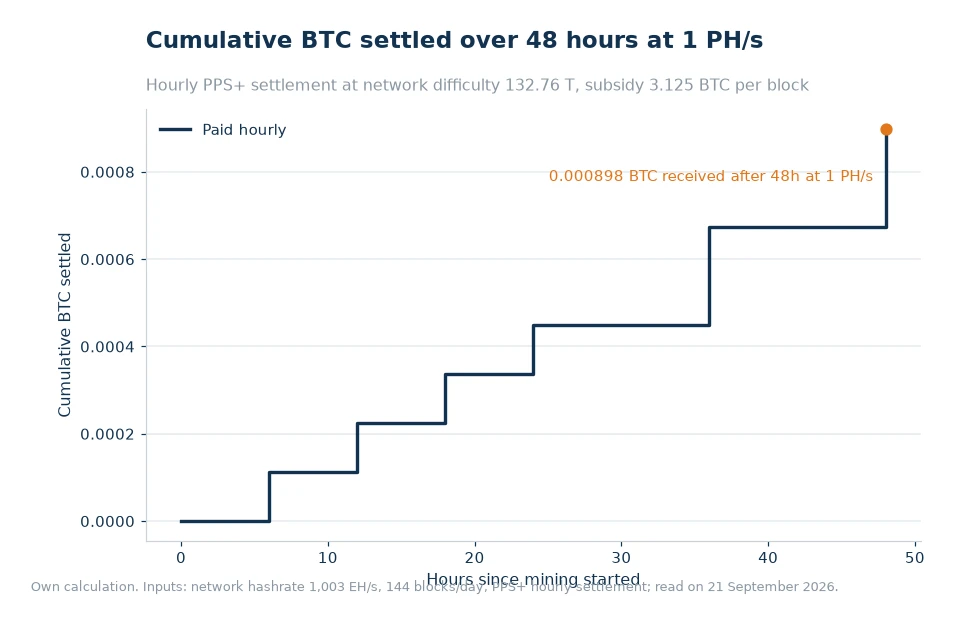
The staircase is the useful mental model. Each step is small enough that a fixed cost per withdrawal — even a modest one — can swallow a whole step, which is why payouts that land hourly should not automatically be moved hourly. Set a threshold instead, and check it against the accelerator's free-tier conditions: a transaction at or under 0.5 KB paying at least 0.0001 BTC/KB qualifies for free priority packing, while anything heavier or thinner needs the paid path in BTC, BCH or LTC, deducted from the account balance.[2]
That arithmetic reads in reverse for small operations: at 10 TH/s the gross figure is about 0.00000449 BTC a day, so the accumulation threshold that suits 1 PH/s is nonsense at that scale.
What to check monthly
Where the coins land matters as much as the format they travel in. A mining wallet that lives inside the same account as the dashboard removes a transfer between platforms and a fee event with it, because zero-fee mining payouts go straight into an account that already holds deposit and withdrawal addresses, balances and an auto-conversion setting. That is how the ViaBTC Crypto Wallet is arranged, and at small ticket sizes the saved step is worth more than any format choice.
Once a month, run the same short pass:
- Split the fee mentally. Note the listed rate and the component it attaches to, then check the same figures against the pool's pool statistics for the period.
- Audit fragmentation. Number of outputs consolidated, number of inputs in the last sweep, and the bytes that transaction occupied.
- Confirm destination formats. Re-check saved payout templates; a format your custody stopped accepting turns an automatic payout into a support ticket.
- Keep the emergency hatch open. If a consolidation could land above 0.5 KB, budget for paid acceleration instead of assuming the free tier will cover it, and never let a withdrawal spend an unconfirmed input.
- Plan for liquidity gaps. If a hardware refresh or an electricity prepayment lands between payouts, short-term borrowing against held assets is a normal operating tool rather than an emergency; collateral-pledged loans work through a fixed sequence — add collateral, apply, receive funds, repay, redeem collateral — so the cost is visible before you commit.
Frequently asked questions
Does the payout method change my average income?
It changes the variance and the fee, not the underlying expected value: your share of network hashrate still sets the ceiling.
How often should a miner check pool statistics?
Weekly is enough for cash flow, daily if you are reconciling worker uptime or chasing a hashrate fault.
Which address format should a miner use for payouts?
Use a format that both your payout system and your custody accept, prefer native SegWit where both sides support it, and keep one format per destination so a batched withdrawal stays predictable.
Can a stuck mining payout be accelerated?
Sometimes. Free priority packing applies to transactions of 0.5 KB or smaller paying at least 0.0001 BTC/KB, with paid acceleration available in BTC, BCH or LTC. A transaction that spends an unconfirmed input cannot be accelerated, and submissions are final.
The short version
Check that your payout system and your custody agree on the address format before you optimise anything else, because a refused payout costs more than a few dozen bytes ever will. Then accumulate to a threshold you can defend with arithmetic, and sweep from confirmed payouts only. Re-read the fee schedule twice a year: the listed 4% and 2% attach to different components of your income.
Data and sources: ViaBTC pricing[1], transaction accelerator documentation[2], public chain difficulty data and the ViaBTC fee breakdown[3]. Network difficulty (132.76 T), network hashrate, the BTC block subsidy and the BTC price (84,692) were all read on 21 September 2026 and every figure shown here is derived from them; values move with difficulty and price.